Aluminium laser welding
As experts in laser material processing, BBW Lasertechnik offers high-quality laser welding solutions for aluminium. Using state-of-the-art laser technology and our in-depth expertise, we can implement your projects efficiently and reliably, providing solutions that are tailored to your individual application and of the highest quality.
Laser welding of aluminium - efficient, precise, economical
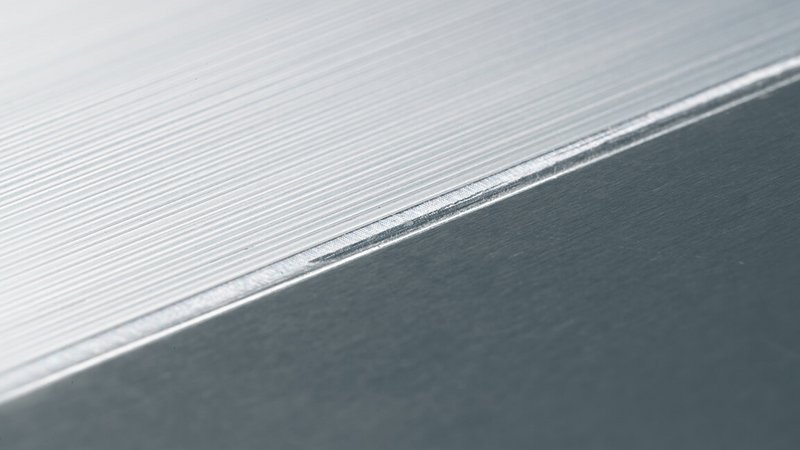
Laser welding is a high-precision process for joining aluminium components. A focused laser beam melts the material with pinpoint accuracy, resulting in stable, clean weld seams — even with complex or intricate geometries.
Thanks to technological advances, even challenging aluminium alloys and die-cast aluminium can be welded to a high standard. This also applies to increased requirements for tightness and strength, such as those commonly found in e-mobility or electronics.
Advantages of laser welding aluminium
Laser welding is a reliable method of joining aluminium, offering technical properties that are advantageous in many industrial applications.
- Narrow weld seams with low material distortion
- Reduced heat-affected zones
- Short process times
- Automated processes
- Joining different aluminium alloys
- Welding without filler material (optional)
The precisely guided laser beam only melts a narrow zone of the workpiece. This produces narrow seams, leaving the surrounding area largely unaffected. This reduces distortion and maintains the component's dimensional accuracy.
The targeted application of energy limits the thermal influence on the component. This significantly reduces the risk of cracks or internal stresses.
Laser welding is a fast and efficient process. The high processing speed ensures short cycle times in production, which is especially advantageous for series applications.
The process can easily be automated and integrated into existing production processes. This results in a reproducible and stable process that is also suitable for large quantities.
Materials with different properties, such as thermal conductivity or alloy composition, can also be joined together. This is possible thanks to adapted process control.
In many cases, filler material can be avoided. This simplifies the process, reducing effort and costs, particularly for precisely fitting components.
Challenges and solutions when welding aluminium
Welding aluminium requires special expertise. Although the material is generally easy to weld, there are some special requirements: For example, the alloys behave differently during welding. Low-alloy aluminium materials tend to form hot cracks under unfavourable conditions. High-alloy variants often contain magnesium, which can evaporate if too much energy is applied. This can result in ejections, which impair the seam quality.
Another risk is the formation of pores. This can be caused by impurities on the component surface or inaccurate process control, among other things. Therefore, it is crucial not only to choose suitable parameters, but also to prepare the workpiece thoroughly.
BBW Lasertechnik addresses these challenges with a holistic approach. This includes using modern laser sources and adapted beam shaping to apply energy in a targeted and controlled manner. Stable process control can significantly reduce critical effects such as cracks, pores and material discharge.
Quality assurance is equally important. Clean component surfaces are a basic requirement for this. As well as conventional cleaning methods, we use laser cleaning — an effective process that precisely removes residues and optimally prepares the surface for welding. To analyse seam quality in detail, we carry out destructive tests such as micrographs. Non-destructive testing methods, such as online process monitoring, are employed as required during series production.
Services at BBW Lasertechnik
We offer our customers a wide range of services in the field of laser welding of aluminium, from the initial idea to series production.
- Process development and welding trials
- Production of samples and prototypes
- Series production in different batch sizes
We work closely with our customers to develop the right solution, tailored to the component, alloy and application. Trial welds help us to define the optimum parameters.
In the early development phase, we produce individual parts or small series. This enables us to evaluate process capability and component properties prior to production.
We offer flexible manufacturing processes for series production. Depending on the quantity and component complexity, we adapt our systems and processes individually.
These services are available regardless of the aluminium alloy used. We also regularly implement the welding of mixed material joints, for example aluminium with copper or stainless steel.
Technical equipment and experience
Our technical equipment is designed for challenging welding tasks. We use modern laser sources and variable welding optics to enable flexible processing strategies. This means that even complex geometries or sensitive materials can be processed reliably.
A well-founded process selection is based on our team’s many years of experience. Thanks to our ongoing development and practical research in aluminium laser welding, we can provide technically and economically viable solutions. We ensure that every project achieves the required quality — reproducibly and stably.
Typical applications for laser welding aluminium
Aluminium is used in numerous industries in which weight, electrical conductivity and heat dissipation play a central role. Laser welding enables durable, material-compatible connections, even with complex geometries and high demands on component quality.
Automotive Engineering
A key area of application is automotive engineering, particularly in the field of electromobility. Here, aluminium components such as busbars, battery contacts and housing parts are manufactured, which require reliable electrical connections and high mechanical stability.

Construction of Battery Modules
This process is also used in the construction of battery modules. Aluminium is used for busbars and cell connectors, among other things. In this context, laser welding offers advantages in terms of tightness, speed of process and consistent quality.

Aerospace Technology
In the field of aerospace technology, every gram counts. At the same time, high demands are placed on load-bearing capacity and safety. Aluminium components, such as structural parts, brackets and sheathing, can be economically joined using a laser without subjecting the material to high thermal stresses.
Mechanical and Plant Engineering
Welded aluminium constructions are used in mechanical and plant engineering for applications such as sensor technology, housing construction and thermally stressed components. The combination of a small heat-affected zone and a strong connection also plays a fundamental role here.

Medical Technology
In medical technology, aluminium is used for delicate housing parts, modular assemblies and heat dissipation plates, to name a few. Laser welding enables clean processing, often without the need for additional materials, which is particularly advantageous for small components with tight tolerances.

Electronics
Another area of application is electronics, particularly for components with high sealing requirements. Laser welding can be used to join die-cast aluminium housings or heat sinks tightly and permanently, which is particularly important in sensitive environments.
Laser welding is a reliable technique for joining aluminium components. It enables economical, clean connections, even with challenging material combinations. BBW Lasertechnik is your point of contact for all matters relating to aluminium welding, from initial ideas to series production.