Copper Laser Welding
Copper has only been reliably weldable with lasers for a few years. This slow progress is due to copper’s high thermal conductivity and, in particular, the material’s low absorption of laser radiation. Because of these challenges, high beam quality must be achieved when welding copper to ensure high intensities. Only high intensities, in turn, enable the reliable coupling of laser radiation into the material to be welded.
Against this backdrop, single-mode fiber lasers or high-power lasers with an output of approximately 5 kW or more, or a focal diameter of 200 µm, are typically used. To achieve the required weld seam qualities in laser welding of copper, advanced beam guidance and shaping technologies are also essential.
When laser welding copper, it is important to note that the deep penetration effect is significantly more pronounced than with other materials. This is because, before the threshold is reached, a high proportion of the laser power continues to be reflected, whereas once the threshold is reached, the laser radiation is almost completely absorbed in the molten pool. This means that there is only a narrow and difficult-to-adjust margin between a surface heat-conducting seam and a deep weld seam. This makes it difficult to precisely set a shallow weld depth.
Copper laser welding is mainly used for functional current-conducting components – for example, in stranded wires, battery components or connectors.

Comparison of different system technologies for continuous-wave laser beam welding of copper
Having already looked at Brightline technology for reducing porosity in aluminium alloys in our last article, today we present a field study on laser welding of copper.
Due to its high reflectivity in the infrared spectrum and high thermal conductivity, copper is very difficult to process using standard industrial lasers – particularly during the initial coupling of laser energy, only a very small proportion of the power can be effectively transferred into the material. In recent years, various technological approaches have been developed to address this challenge. At BBW Lasertechnik, we have directly compared three of the most promising approaches in an internal field study:
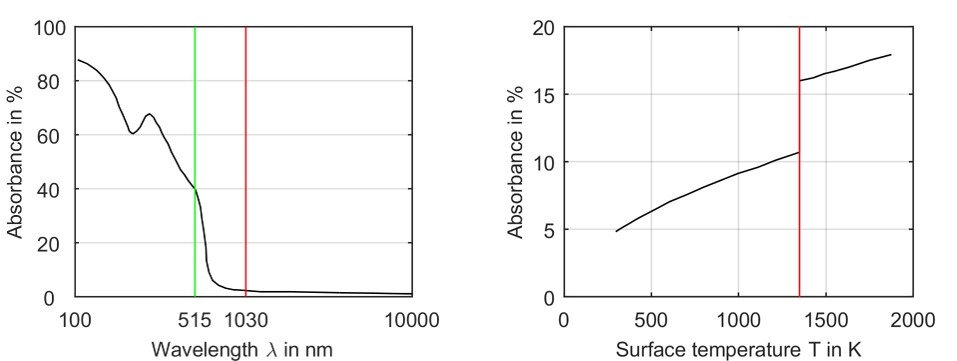
First, some basic information about copper as a material: in the infrared spectrum and at room temperature, copper absorbs only around 3 to 5 % of the energy incident on the material (Figure 1). This percentage increases as the copper heats up and multiple reflections occur during deep-seam welding. In addition, there is a sharp increase in absorption at the transition from solid to liquid copper. This gives rise to two key challenges: Firstly, sufficient energy must initially be transferred into the copper material so that, secondly, a stable welding process can be achieved. Due to these conditions, clean, shallow heat-conducting welds are virtually impossible to achieve, and the risk of weld irregularities, such as spatter and molten metal ejection, is significant.
Approach 1: Oscillating laser beam welding
Klassisches Laserstrahlschweißen mit optionaler Oszillationsbewegung
Conventional laser beam welding with optional oscillatory motion
In the first approach, we examine the parameter range within which stable welds can be achieved using a standard industrial laser. In the series of experiments shown in Figure 2, welds produced at two welding speeds (6 m/min, top; and 12 m/min, bottom) and different wobble frequencies (none, 200 and 400 Hz) are compared.
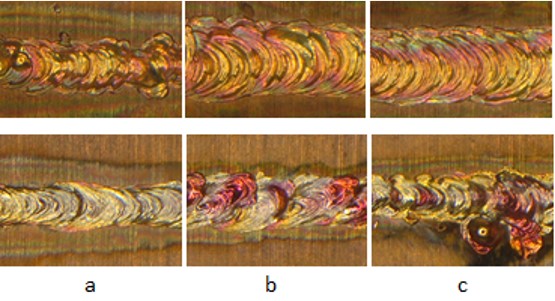
This results in two parameter combinations that produce a stable weld. At low feed rates (for example, when deep penetration is required), it is essential to incorporate an additional oscillating motion at a moderate frequency. To achieve this, the laser beam is wobbled in a circular or sinusoidal pattern in addition to the feed direction (other patterns are also possible), which can be achieved using a dynamic scanner. Without this additional movement, the welding process becomes unstable and results in significant spatter, as shown in Figure 3 (without additional movement, left; and with additional movement, right).

A second process window arises at high welding speeds >9 m/min, where no additional movement is required. The drawbacks of high welding speeds include a reduced achievable penetration depth and the need for a high-power laser.
Approach 2: 2-in-1 fibre and the use of beam superposition
Konzentrische Überlagerung zweier Laserspots mit unterschiedlicher Strahlform durch eine 2-in-1-Faser (Brightline oder ähnliches)
Concentric superposition of two laser spots with different beam shapes using a 2-in-1 fibre (Brightline or similar)
In the first approach, we examine the parameter window within which stable welds can be achieved using a standard industrial laser. In the series of experiments shown in Figure 2, welds are compared at two welding speeds (6 m/min, top; and 12 m/min, bottom) and different wobble frequencies (none, 200 and 400 Hz).
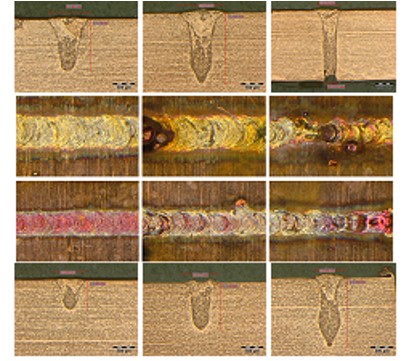
It is clearly evident that the more power is shifted to the outer ring fibre, the higher the weld quality achieved, which can even be compared to a heat-conducting weld. At the same time, the weld depth decreases significantly. Spatter and molten metal ejection occur only rarely in this process. The seam quality is higher compared to wobble welding; furthermore, all welding speeds are possible. However, the welding depth achieved with wobble technology is not reached.
Approach 3: 'Green' laser sources
Laserstrahlquelle mit einer Wellenlänge im grünen Spektrum
Laser source with a wavelength in the green spectrum
Green laser beam sources in the multi-kW range have only been on the market for around two years (max. 2 kW, as of late 2020). If we look again at the absorption spectrum of copper, a significantly higher absorption in the green range is evident (40% instead of 5%). This means that significantly lower power levels are required for a comparable weld depth. At the same time, there is no absorption jump during the transition from solid to liquid copper, which results in significantly higher process stability and also allows for a heat-conducting weld with a shallow penetration depth without any issues. This technology is therefore characterised by excellent control over the penetration depth and the possibility of using wobble technology with a scanner optimised for the green wavelength. However, the seam quality does not match that achieved with beam superposition; furthermore, the welding depth is limited due to the low laser power.
Conclusion
A stable process window for copper welding is achievable with each of the technologies considered. Ultimately, each technology has its advantages and disadvantages:
- The greatest control over weld depth is achieved with a green laser source. Heat-conductive welds are also possible. A disadvantage is that green laser sources are still limited in terms of power.
- The best ratio between weld depth and laser power used is achieved with wobble technology. This technology can also be combined with a green laser source.
- The best seam quality is achieved with the 2-in-1 fibre (Brightline) technology, as, with the correct parameters, seams of a quality comparable to a heat-conducting seam are possible.
From BBW Lasertechnik’s perspective, combining a green laser source with 2-in-1 fibre technology would be highly interesting, as this combines the respective advantages. However, we are not developers of new laser technologies, but primarily users. It therefore remains to be seen whether colleagues at renowned laser source manufacturers also view and investigate this trend in the same way.
The results from this field study are an extract from the article ‘Comparison of different technologies for continuous-wave laser beam welding of copper’ (https://doi.org/10.1016/j.procir.2020.09.081) published in Procedia CIRP and were also presented at LANE 2020.